- About this Archives in Brief
- What are inquests?
- How do you know if an inquest was held?
- If there was foul play…
- Inquests before 1825
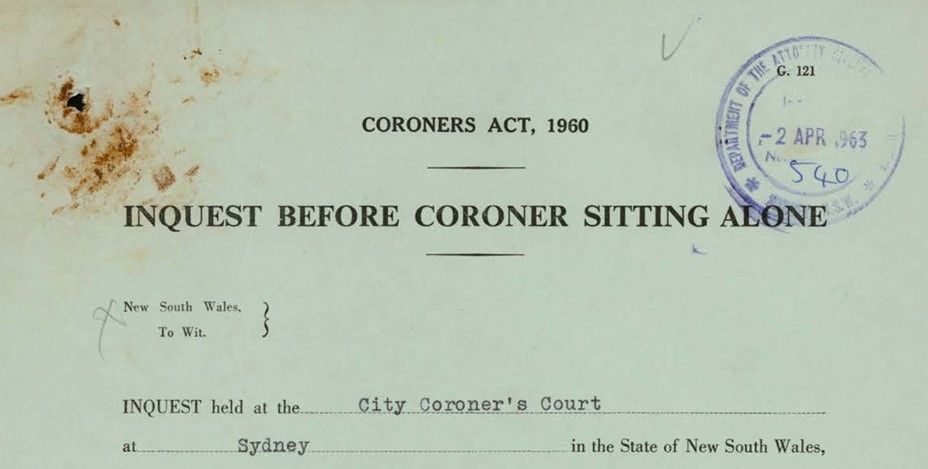
- Inquests 1826-1963
- Inquests for specific localities
- Related records
- Access
About this Archives in Brief
This AIB describes the key records held by State Records relating to inquests in New South Wales. For further details researchers should consult Archives Investigator, Short Guide No. 2 Birth, Death and Marriage records and the Guide to the Archives Resources Kit.
For further information about the current coronial system in New South Wales, check the Local Courts website.
Researchers should consult the Register of Access Directions to confirm the public availability of records. State Records' staff can advise you on the availability of records if they are not listed on the register.
What are inquests?
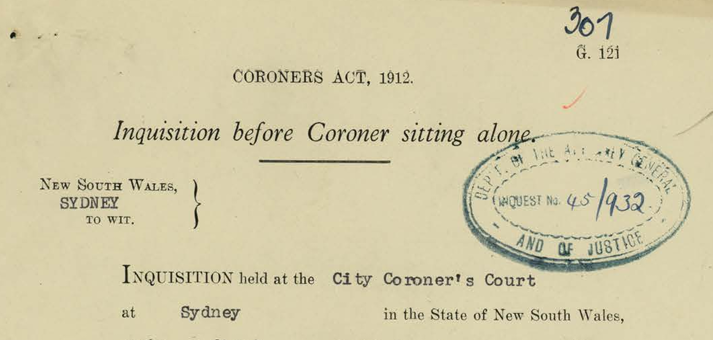
Inquests are conducted by coroners and are held to investigate the manner and cause of death. Under the Coroners Act, (No. 27, 1980) Coroners must hold an inquest when the deceased person is not identified, when the cause of death is not determined, when the person died as a result of a homicide, or if the person died in or attempting to escape from police custody. A coroner may also be directed to hold an inquest by the Attorney General or the State Coroner.
Coroners were also authorised to hold inquests to examine any sudden or unnatural death, occurring as a result of an accident, suicide or act of violence. Inquests can also be held into deaths which occurred in hospitals, asylums gaols and other public institutions, and into any fire which may have caused the destruction of property or injury to a person.
Reports of death
Deaths in certain circumstances must be reported to the Coroner. These circumstances include sudden, violent or unnatural deaths, deaths of persons in institutions or in police custody, and deaths within 24 hours of, or as a result of the administration of anaesthetic. These may or may not result in an inquest.
Inquests dispensed with
Not all reports of death result in an inquest. Under the current Act a coroner may dispense with an inquest the circumstances around the death or fire are sufficiently disclosed to make a formal court hearing unnecessary.
Missing persons
Missing persons must be declared dead by the Coroner. This must occur before the estate can be settled.
How do you know if an inquest was held?
The death certificate
The death certificate should show whether an inquest was held, or if an inquest was 'dispensed with'. Indexes to death certificates, 1788-1945 are available in the reading rooms or online at the Registry of Births, Deaths and Marriages website.
Inquest indexes
If the approximate date of death is known, it is possible to check indexes to inquests for the appropriate year, under the name of the deceased. An inquest is not always held at the time of death. You may need to look in the years following the known date of death or try looking for a report in the newspapers of the time.
Newspapers
You may locate a report about an inquest in a newspaper. State Records does not hold copies of newspapers. Contact the State Library of NSW or public libraries in the local area.
If there was foul play…
If there was foul play involved in a death, such as murder or manslaughter, Coroner's records can sometimes lead on to other court records. There may also be information in newspapers published at the time.
Inquests before 1825
Judge Advocate
| Title | Series | Copy | *ARK |
|
Reports of inquests, 1796-Apr 1824 |
Reels 2232-2233 |
Colonial Secretary
| Title | Series | Copy | *ARK |
|
- |
- | ||
|
Proceedings of coroner's inquests, 1809-22 |
Reels 6021; 2928 |
Coroners and Morgue
| Title | Series | Copy | *ARK |
|
Verdicts in inquests - County of Buckinghamshire, Van Diemen's Land, May 1815-Sep 1819; County of Cumberland (NSW), Jun 1828 |
Reel 2667 |
|
Inquests 1826-1963
Indexes
For some years, for example, May 1859-Mar 1864 indexes are the only surviving records relating to inquests. For further information about an inquest in this period check newspapers.
The Guide to Using the Archives Resources Kit and Short Guide 2: Birth, Death and Marriage records provide full listings of these records.
| Title | Series | Copy | *ARK |
|
Card index to inquests, 1834-36, 1839-44, 1852-58, 1867-68, 1870-75 |
- |
- |
|
|
This index was compiled by State Records staff and is held at the Western Sydney Reading Room. It complements the following series NRS 344. 1839-44 lists surnames A-G only. | |||
Attorney General and Justice
| Title | Series | Copy | *ARK | |
|
Indexes to registers of coroners inquests, 1859-98 |
Reels 2224, 2926-27 | |||
|
This series is incomplete. It is complemented by the card index to inquests, listed above. | ||||
|
Register of Coroners inquests and magisterial inquiries, 1834-1942 |
Reels 2921-25, 2225, 2763-65, 2766-69 | |||
|
Between 1899 and 1942 an index is included in the front of each register. | ||||
|
Card register to inquests, Jul 1942-Jun1963 |
- |
| ||
|
The cards are arranged alphabetically for each six-month period. | ||||
Registers of inquests
Earlier registers will show district, before whom inquest held, when and where held, date received, name of deceased, finding and date death certificate required. The later registers also record age of deceased, locality of birth, locality of death, and cash or property owned at the time of death.
Though the registers can sometimes provide additional information, they usually reflect that on a standard death certificate. For more information researchers should consult the Guide to Using the Archives Resources Kit and Short Guide 2 Birth, Death and Marriage records.
Attorney General and Justice
| Title | Series | Copy | *ARK | |
|
Register of Coroners inquests and magisterial inquiries, 1834-1942 |
Reels 2921-25, 2225, 2763-65, 2766-69 | |||
|
Registers have not survived for the period May 1859-Mar 1864 (although index entries may be found). | ||||
Inquest papers
Information found within the papers may include particulars relating to the deceased, such as age and locality of death, circumstances surrounding the death, copy of the coroner's findings, names of members of the jury and also names of witnesses and their testimonies. When an inquest was related to a fire, information given may include the address of the dwelling and the name of the occupants and owner.
The papers can be a valuable source of information and may include statements from witnesses, police and medical officers. Information may also include a record of personal items found on the deceased and occasionally photographs of the death scene or the victim. For this reason, they may be distressing to the researcher.
If further court action arose out of the inquest, the inquest papers may be filed with the later court papers.
The inquest files are indexed and the indexes are listed above. The files concerning reports of deaths, inquests dispensed with and magisterial inquiries are not indexed. These files are listed in date order. The lists are available in the reading rooms.
Attorney General and Justice
| Title | Series | Copy | *ARK | |
|
Coroners' inquest papers (Files concerning inquests, magisterial inquiries and inquests dispensed with), 1851-1963 |
- |
| ||
|
Inquest papers have survived for some localities in 1851. A small sample of files from 1916, 1918-20, 1921-39 have survived. Click here to view a list of surviving papers for 1916-39. The bulk of the papers of 1940-63 have survived. These papers are located at the Western Sydney Records Centre. | ||||
|
Letters received, 1918-20 |
- |
| ||
|
A number of files relating to inquests are included with the correspondence. These inquests were passed on to the Attorney General because the Coroner had brought down an open verdict or a reward was offered to bring forward more information | ||||
Inquests for specific localities
Occasionally there are records for specific localities. Where these survive, they are listed in Archives Investigator.
Related records
Pharmacy Board
| Title | Series | Copy | *ARK |
|
Register of deaths by poisoning, 1924-39 |
Reels 3147-3148 |
| |
|
Information provided may include the name of the deceased, date of death, place of death, poison, how poison was administered and remarks. | |||
Other records
The following are descriptions of typical records that may survive for specific localities. Surviving records are listed in Archives Investigator.
Registers of bodies received
The registers show the number of the body and date received, name, sex, age, birthplace, occupation, where and when found, remarks, description and a statement of wounds or injuries.
Post mortem registers
Post mortem registers list the date of death, date of autopsy, doctor and medical attendant, name of deceased, birthplace, age, occupation, previous history and habits of the deceased, circumstances surrounding the death, remarks, external description, result of post mortem, cause of death, doctor's signature and date.
Internal examination registers
These record the name of the deceased, date of autopsy, cause of death, age, occupation, birthplace, date of death, by whom identified, circumstances relating to the death, and details of medical examination.
External examination registers
These may provide the name, age and birthplace of the deceased, occupation, date and results of examination, remarks and signature of the pathologist.
*ARK signifies that a copy of the record or guide is part of the Archives Resources Kit and is held by the community access points.
Access
Researchers should consult the Register of Access Directions to confirm the public availability of records. State Records' staff can advise you on the availability of records if they are not listed on the register.
© State of New South Wales through the State Records Authority, 2003.
This work may be freely reproduced and distributed for most purposes, however some restrictions apply. See our copyright notice or contact us.