![]() |
A Guide to New South Wales State Archives relating to Aboriginal People |
Part 1: Archives of the Aborigines Welfare Board 1883-1969
![]()
The Board for the Protection of Aborigines, later the Aborigines Welfare Board, held weekly meetings from 1890 to 1915, and then monthly meetings until 1969, when the Board was abolished. Minutes of proceedings were kept for each Board meeting and were read and approved at subsequent meetings. The Minutes note members present and record the decisions of the Board.
The early part of this series is in the form of agendas consisting of matters arising from previous meetings, business with other Departments, especially the Police and the Lands Department, and business with the Local Boards. These matters were entered into the Minutes book in preparation for discussion. Some of the early minutes in this series overlap because there was an attempt to have a copy made of several Minute books. Statements of accounts, monthly at first, then more frequently, were prepared for the agenda. By about 1897 these were consuming too much space, and it appears that separate accounting records were kept with only the total expenditure and balance recorded in the agenda.
Following the Aborigines Protection Act 1909 (No. 25), the functions of the Board widened, becoming more inter-departmental, and consequently the minutes become more voluminous. This necessitated the discontinuance of the agenda-type minute around 1915, when the 1909 Act was amended by the Aborigines Protection Amending Act 1915 (No. 2). At this time the Minute books begin to include loose documents, such as typed financial statements, important correspondence, transcripts of Board meetings, and notices of Board members and meetings, as well as a record of attendances, and dates of appointments. After the reconstitution of the Board in 1937, the minutes give the decisions of the Board in point form, followed by a statement of expenditure. Later the minute items usually give a correspondence file number.
Because of their summary nature, Minute books do not give great detail about individuals. However, the mention of that individual may be the only reference to the person in official records. Therefore, careful checking of the Minute books may prove worthwhile to researchers.
| Arrangement | Chronological |
| Indexes | 1890-1945 in front of volumes; |
| 1946-1969 separate volumes - See Indexes to Minute books, 1946-69 | |
| Reference Numbers | 4/7108-7127, 4/8544-8548; AO Reels 2788-2794 |
These volumes are an alphabetical index to Minute books, 1890-1901, 1905-06, 1911-69. Before 21 May 1946, the Minute books had indexes incorporated within them. The index method is to give the item number, then the page number.
| Arrangement | Alphabetical |
| Reference Numbers | 4/8549-8551 |
| Reference Nos. | Dates |
| 4/8549 | 21 May 1946-17 November 1953 |
| 4/8550 | 15 December 1953-c.16 February 1965 |
| 4/8551 | 25 May 1965-29 April 1969 |
The Aborigines Protection Act 1909 (No. 25) provided for the appointment of Local Committees (previously Local Boards), who worked in conjunction with the Aborigines Protection Board. These committees were also known as Aboriginal Protection Committees and Local Aborigines Committees.
This volume contains the minutes of the monthly meetings. It also contains a letter from the Board approving appointment of a member to the Local Committee dated 12 August 1918. At the back of the volume is a postage stamp account for 1 December 1914-21 August 1915.
| Reference Number | 5/18423.3 |
| Dates | 15 April 1911-2 October 1918 |
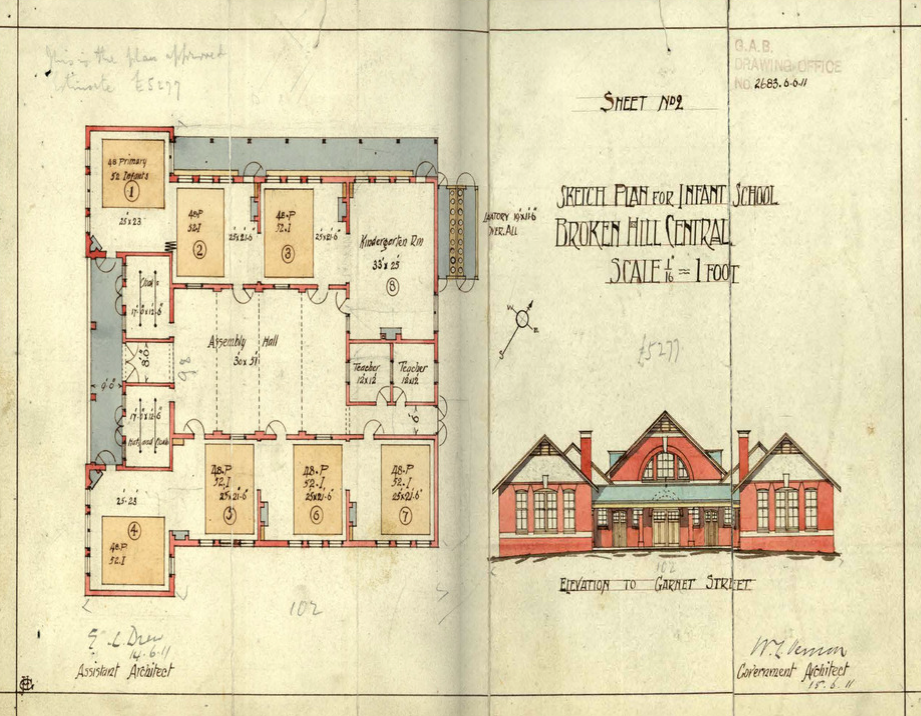
The bulk of these files are registered in a `C' series of numbers, although most of them seem to include a number of letters registered in an `A' series. The registers for this correspondence do not appear to have survived. The subject range of these files is broad and relates to such matters as: reports on conditions of reserves; Inspector's diaries; case histories of ex-wards of the Board; applications for wards; acquisitions of land and the purchase or construction of houses; repairs and maintenance of properties; tenancies; house loans; education grants; applications for certificates of exemption which usually include a small photograph of the applicant; social aid to Aboriginal people; and files relating to general administrative matters. Many files contain maps and plans from the Government Architect's Office; and others contain black and white photographs.
When the files were re-boxed after being transferred as State archives it was found that the connections between some files had been lost; and in some cases single sheets or parts had been separated from their original files. Correspondence in these categories is located at 8/2754.1 (1945 and 1949 registered files) and in 8/3045, which includes files and papers dating from 1938 to May 1968.
A sample of silk screen printing, circa 1964, which was attached to File C19981 and located at 8/2971.1 has been extracted and placed at AO Document No. 177. This sample is a three colour design (red, yellow and blue) on linen and shows a rural scene, overprinted with the words Greetings from Kempsey.
Letters to the Board before 1949 do not appear to have survived, although there is some earlier correspondence within these files. Some correspondence relating to the administration of Aboriginal affairs and the Board appears in the correspondence of the Chief Secretary. Many of these letters were forwarded to the Board, but apparently have not survived, as these letters appear neither in the Chief Secretary's correspondence nor in the Board's records. After the abolition of the Board in 1969 many of the correspondence files of the Board were transferred to the Aborigines Welfare Directorate of the Department of Youth and Community Services where they were re-registered (See Aboriginal Services Branch. Correspondence ('D') files, 1969-81).
An index to the Correspondence files, 1945-1969 was compiled by Ken Brindle in 1987. The Archives Authority has a copy of this index which, like the correspondence itself, is restricted. The Department of Aboriginal Affairs also holds the index which it may check on behalf of enquirers. However, the Department of Aboriginal Affairs does not hold the files themselves. A manuscript copy of the index is also held by the Australian Institute of Aboriginal and Torres Strait Islander Studies in Canberra.
At the time of publication of this Guide the Correspondence files are being microfilmed.
| Arrangement | Chronological and numerical by file number |
| Registration system | Running number for 1949 with `A' prefix, running number from 1950 to 1966 with `C' prefix, and annual running number from 1966 to 1969 with `C' prefix. |
| Inclusive numbers | A1302-A1400; C1-C23072, C66/12-C69/498 |
| Reference Numbers | 8/2754-3045; AO Document No. 177 |
This is a colour-coded card index to the Correspondence files, 1949-69 (see Correspondence files, 1949-69). The cards are arranged in two main sequences: 1. names of individuals (blue cards) interfiled with subject cards (orange cards); and 2. cards arranged by place name. Personal index cards (blue) refer to matters such as rent arrears, medical treatment and applications for financial loans; subject and place name cards cover a wide range of administrative matters associated with the running of Aboriginal stations, reserves and homes. They also include reference to such matters as: the preservation of Aboriginal relics; the establishment of a Save the Children Fund; the right to join sports clubs; and the production of films, such as the ABC film Breakaways.
The remaining cards are grouped together under headings which include: Miscellaneous; Area Welfare Officers; Aborigines Welfare Board Trust Account; General matters; Pensions; Endowments; Capital Fund Loan Applications; Passes (ie. travel); and Rates, sanitary, garbage and water charges. The file numbers on the cards refer to the Correspondence files, 1949-69, although it should be noted that many of the files appear not to have survived.
| Arrangement | Roughly alphabetical by name or subject |
| Reference Numbers | 4/10795-10796 |
| Reference Nos. | Description |
| 4/10795 | Names of individuals and subject cards |
| 4/10796 | Cards arranged by place name and other headings |
This volume is comprised of copies of circulars sent by the Board to Area Welfare Officers, Managers of Stations, Supervisors of Reserves, and Officers-in-charge of Police Stations. The subjects of the circulars relate to: policy matters (eg. Disciplinary Action on Stations and Reserves; Assimilation of Aborigines into the General Community-Clarification of Policy; and Duties and Responsibilities of Area Welfare Officers); general welfare matters (eg. Payment of Unemployment and Sickness Benefits to Aborigines); lists of names of people granted certificates of exemption from the provisions of the Aborigines Protection Act and Regulations; requests for information from the stations and reserves (eg. Contract Schedules; dairy livestock; information for the Board's Annual Report). The circulars give the circular number (a single running number), the file number (eg. C8945), date, to whom sent, subject and the signature of the Superintendent. It is indexed in rough alphabetical order at the front of the volume, and the index gives the circular number, the page number of the volume, and the file number.
| Arrangement | Numerical and chronological |
| Index | Roughly alphabetical in front of volume |
| Inclusive numbers | 574-924, 982 |
| Inclusive dates | 12 November 1952-2 October 1956, 3 October 1957 |
| Reference Number | 4/8552 |
Certificates of exemption were applied for under the provisions of the Aborigines Protection Act and Regulations 1909-43, section 18C (Regulation 56). A certificate of exemption was granted to each applicant who in the opinion of the Aborigines Welfare Board ought to no longer be subject to the provisions of the Aborigines Protection Act and Regulations. Upon being issued with a certificate, a recipient was no longer eligible to receive any benefit, assistance or relief from the Board, and had to undertake to provide a proper home for himself/herself and his/her family. See also Correspondence files, 1949-69.
| Reference Numbers | 8/3089-3098 |
A certificate of exemption was granted to each applicant who in the opinion of the Aborigines Welfare Board ought to no longer be subject to the provisions of the Aborigines Protection Act and Regulations. A recipient was no longer eligible to receive any benefit, assistance or relief from the Board, and had to undertake to provide a proper home for himself/herself and his/her family.
These appear to be a duplicate set held by the Board.
| Reference Number | 8/3275.1 |
This is a blank certificate.
| Reference Number | 8/3275.2 |
This series is incomplete; there are cards for only six people. This series consists of two separate types of cards. The first, the Aboriginal child record card, details: surname; Christian names (editorial note: this is the language as it is used in the record); if Board assumed control - date and reason; admitted to homes; discharged; education and training; health; conduct and character; training and progress; and if apprenticed date of first appointment. The reverse of these cards details: date and movement (eg. to homes); date and inspection; observations; and general remarks. The second type of card, the Aborigines record card, details: surname; Christian names (editorial note: this is the language as it is used in the record); caste (editorial note: this is the language as it is used in the record); colour shade (editorial note: this is the language as it is used in the record); sex; date of birth; religion; father's surname and Christian names (editorial note: this is the language as it is used in the record); mother's maiden surname and Christian names (editorial note: this is the language as it is used in the record); details of marriage - date, to whom, place (often siblings are listed here); details of children - name, date of birth, place where born; details of death, date, place of burial. Family endowment, character and general habits are also recorded. The reverse of these cards details: general information - occupation and movements and details of employment (this often lists in whose care children have been placed). These cards appear to be the Board's set as some are marked as having copies sent to Kinchela or Cootamundra. There are both cards for most people covered by the series, but not all.
| Reference Number | 8/3275.3 |
The Board could assume full control and custody of the child of any Aboriginal person if after due inquiry the Board was satisfied that it was in the interest of the moral or physical welfare of the child. These volumes contain the forms filled in when a child was made a ward of the State. They give: the consecutive number of the form; date; name; date and place of birth; religion; reason for assuming control of the child; father's name; occupation and address; mother's name and address; particulars of other relatives including brothers and sisters; other situations; further particulars (where living during childhood and in whose care); to which Home sent; certificate of admission; disposal (editorial note: this is the language as it is used in the record); and signature and office (although the forms are usually unsigned, some are signed by either police or managers of stations or reserves). There are usually some later annotations giving further details. Occasionally correspondence is attached to the form.
| Arrangement | Chronological and numerical | ||||
| Reference Numbers | 4/8553-8554; AO Reel 2793 | ||||
| Reference Nos. | Reel | Dates | Nos. | ||
| 4/8553 | 2793 | 18 January 1916-2 June 1923 | 1-500 | ||
| 4/8554 | 2793 | 28 June 1924-7 Dec. 1928 | 501-800 | ||
These volumes, entitled `Index to Histories of Aborigines Children', index the series Ward registers (see Ward registers, 1916-28). The volumes are arranged alphabetically in two columns, girls and boys, and record name and relevant entry in the Ward registers. Volume 4/8556 appears to be a rough copy of volume 4/8555. The entries in volume 4/8555 go up to number 1454, although the surviving Ward registers only go up to number 800.
Volume 4/8555 includes a list of children at Bomaderry dated 4 October 1935 and lists of boys at the Aboriginal Boys' Training Home, Kinchela dated 27 July 1934, 31 October 1935 and 31 January 1936. These lists usually include the name of the child, age and from where transferred. 4/8555 also includes names of some girls in suburban situations and in hospitals and institutions at the back of the volume. There are a few notes included in each volume of names and addresses and references to birth , marriages, deaths and transfers.
| Arrangement | Alphabetical by name of girl or boy | |
| Reference Numbers | 4/8555-8556 | |
| Reference Nos. | Dates | Numbers |
| 4/8555 | 1916-c.1938 | 1-1454 |
| 4/8556 | 1916-c.1930 | 1-848 |
| Note: There are ten years of index entries with no surviving registers. | ||
![]()
May 1998
The State Records Authority of New South Wales
Sydney NSW, Australia.
© Copyright reserved by the Government of New South Wales, 1998. All rights reserved.
No part of this publication may be reproduced by any method without the prior written consent of the State Records Authority of New South Wales.
ISBN 0 7310 1737 4 First published 1998.
[Home] [ServiceNSW] [Privacy Policy] [Disclaimer & Copyright Notice] |
|||||
© Government of
NSW Please make
queries or comments respecting the State Records Website |
|||||