Today in History - May
May 1
On this day in 1815 the Supreme Court of Civil Judicature was opened by its first judge, Jeffrey Hart Bent. He in turn swore in William Broughton and Alexander Riley as magistrates. The Supreme Court was established by the Second Charter of Justice in 1814 and dealt with pleas of debt, account or other contracts, trespasses and other personal pleas. The Court was abolished by the Third Charter of Justice in 1823 and replaced by the Supreme Court of NSW that dealt with both civil and criminal jurisdictions.
- See entry in Colonial Secretary's Index under Jeffrey Bent
- See entry in Colonial Secretary's Index under William Broughton
- See entry in Colonial Secretary's index under Alexander Riley
- Search the Index to the Court of Civil Jurisdiction, 1799-1814
- Search Court of Criminal Records 1788-1833 online index
- See our Court Records resource page
May 3
On this day in 1841 New Zealand was proclaimed a separate Crown colony from New South Wales. Captain William Hobson declared British sovereignty over all of New Zealand on 21 May 1840 and it was treated as part of the Colony of NSW for nearly a year.
- See our New Zealand page which looks at the relationship between New South Wales and New Zealand from the early 1800s to Federation
- Search Archives Investigator: Simple search using keywords 'New Zealand'
May 4
On this day in 1842 the colony of Moreton Bay was declared a free settlement. The settlement was established by John Oxley in August 1824 and up until 1842 was primarily a place of secondary punishment for convicts who got into trouble while serving their original sentence in NSW. At the height of the penal colony in 1829 there were nearly 1000 convicts but by 1839 only 107 remained. Queensland was declared a separate colony from NSW in 1859.
- A Tracing of Map of Brisbane in 1842 in the Colonial Secretary's Papers as part of 42/8789 can be viewed in the reading room
- See entry in Colonial Secretary's Papers under John Oxley
- See entry in Colonial Secretary's Papers under Moreton Bay
May 5
On this day in 1865 bushranger Ben Hall was shot dead. Ben Hall was also known variously as Bold Ben Hall, Brave Ben Hall and the Gentleman Bushranger. Between 1863 and 1865 there were over 100 robberies attributed to him and his gang. Hall also worked with fellow bushranger Frank Gardner, most noticeably combining to rob the gold escort coach near Eugowra in June 1862. Ben was ambushed and shot by Police. He was buried in the Forbes cemetery.
- there are numerous references to Ben Hall in the Police Gazettes (can be viewed on microfilm in our reading room)
- there are also a number of letters related to Ben Hall in the Colonial Secretary's Papers from 1864-65 (the index can be searched in our reading room)
- see our fact sheet, Archives in Brief 69 - Cemetery records
- see our Bushrangers Gallery
May 6
On this day in 1873 a State funeral was held in honour of William Wentworth, who had died in England on March 20, 1872. Wentworth was well-known as an explorer (he found a route over the Blue Mountains along with Blaxland and Lawson), as an entrepreneur (he founded The Australian, NSW's first privately owned newspaper), as a politician (he was elected to the Legislative Council in 1843) and as landowner (he built Vauclause House and the surrounding estate).
- See entry in Colonial Secretary's Papers under William Wentworth
- See our Blue Mountains Gallery
- Vaucluse House

May 7
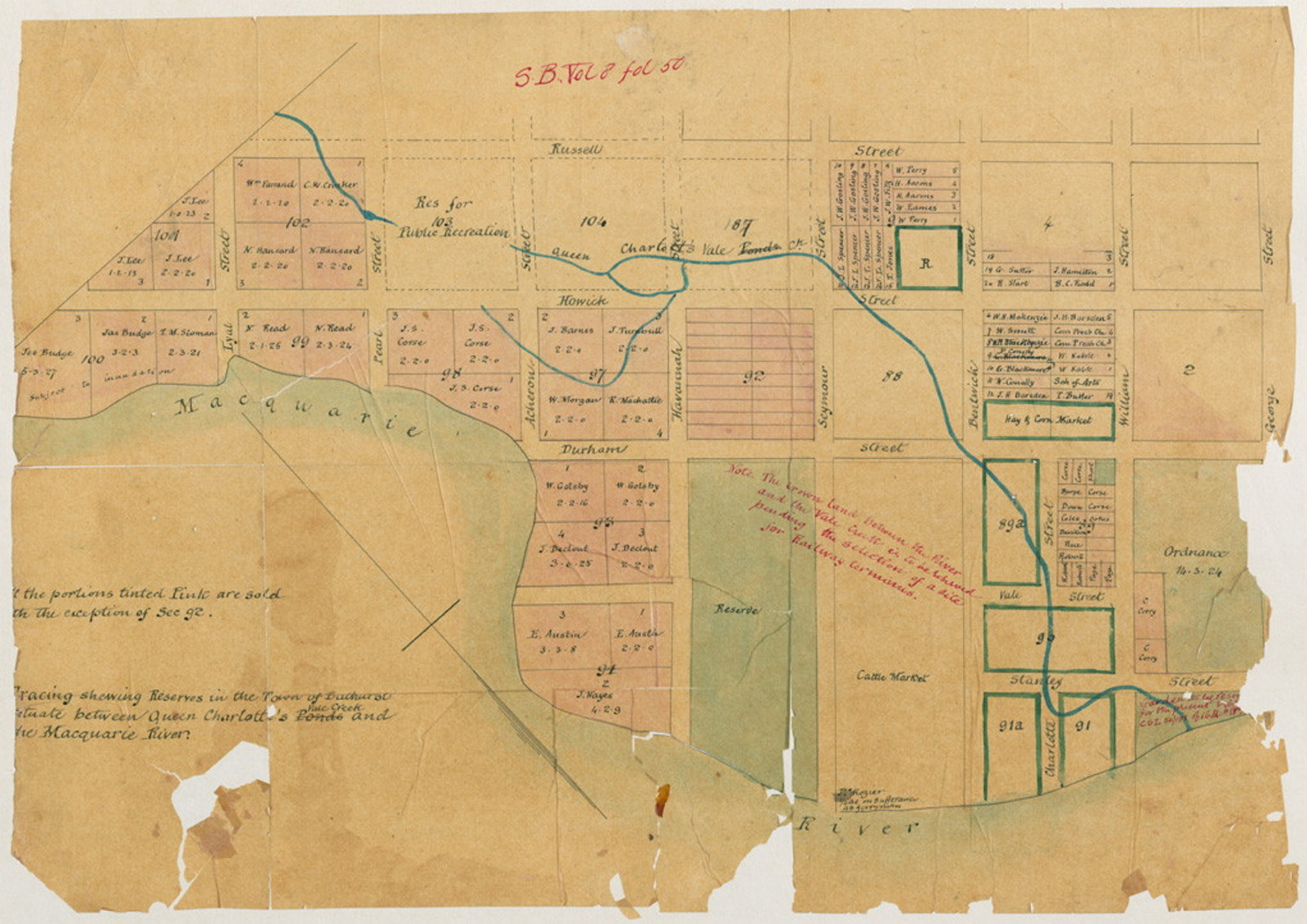
On this day in 1815 Governor Macquarie named the town of Bathurst. Governor Macquarie travelled from Sydney to Bathurst on the newly completed Great Western Road in 11 days. The road was built by William Cox. It started at Emu Plains and was 161 km long with 12 bridges. It was the first road over the Blue Mountains.
- See entry in Colonial Secretary's Papers under William Cox (Senior)
- See entry in Colonial Secretary's Papers under Great Western Road
- See the Lachlan Macquarie: Visionary and Builder Gallery
May 11
On this day in 1813 Gregory Blaxland, William Lawson and William Wentworth departed Sydney on an expedition to find a route over the Blue Mountains. The trio reached Mt York on May 28 and three days later arrived at Mt Blaxland. At this point they turned back to Sydney having sighted the plains beyond and found a passage over the Blue Mountains.
May 12
This day is International Nurses Day. Nurses have long played an important role in the hospitals of NSW.
- See our fact sheet, Archives in Brief 118 - Nurses
- See Short Guide 10 Professions and occupations
- Browse photos of nurses

May 13
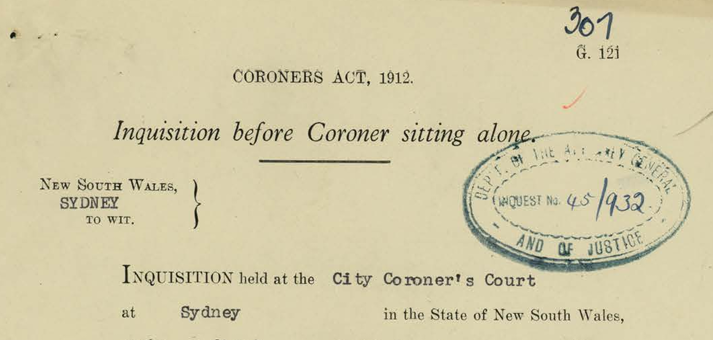
On this day in 1932 the NSW Premier, Jack Lang, was dismissed from office by NSW Governor Sir Philip Game. Lang is the only Premier of an Australian state to have been dismissed by the state Governor. The NSW government had accumulated large loans and during the Great Depression could not meet the interest payments. Lang found himself in a stand-off with the Commonwealth Government and withdrew £1 million of NSW Government money from the bank to prevent the Commonwealth Government from seizing it. Lang was replaced by Bertram Stevens and he then lost the June 11 state elections.
- See Archives Investigator NRS 4545 for more details about conflict
(available on microfilm in the reading room) - Sir Philip Game and Mr J.T. Lang
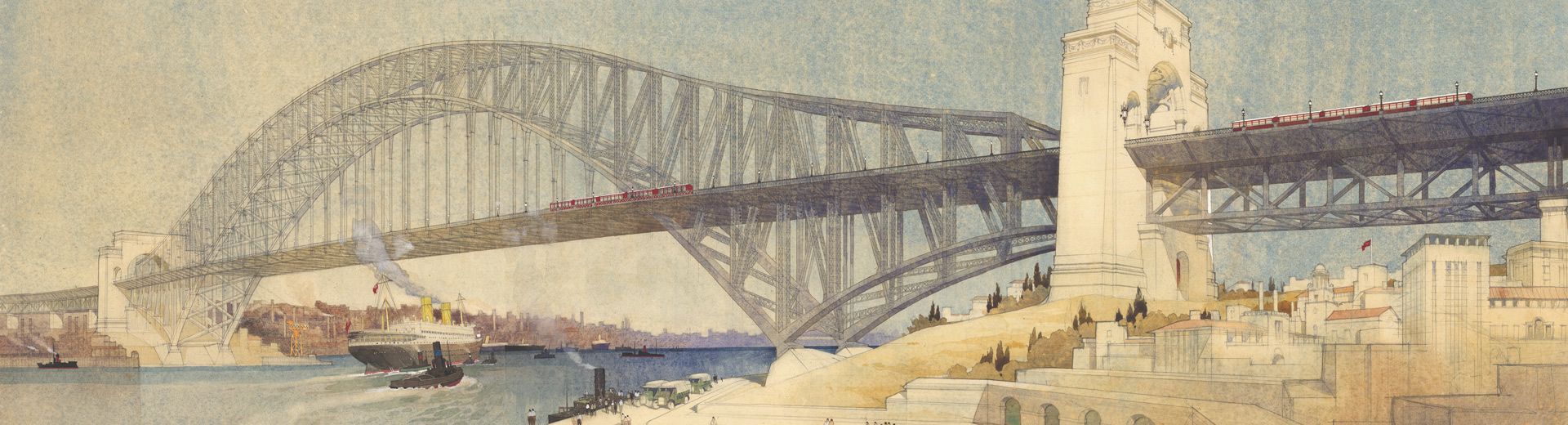
(official opening of the Sydney Harbour Bridge, 19 March 1932)
May 14
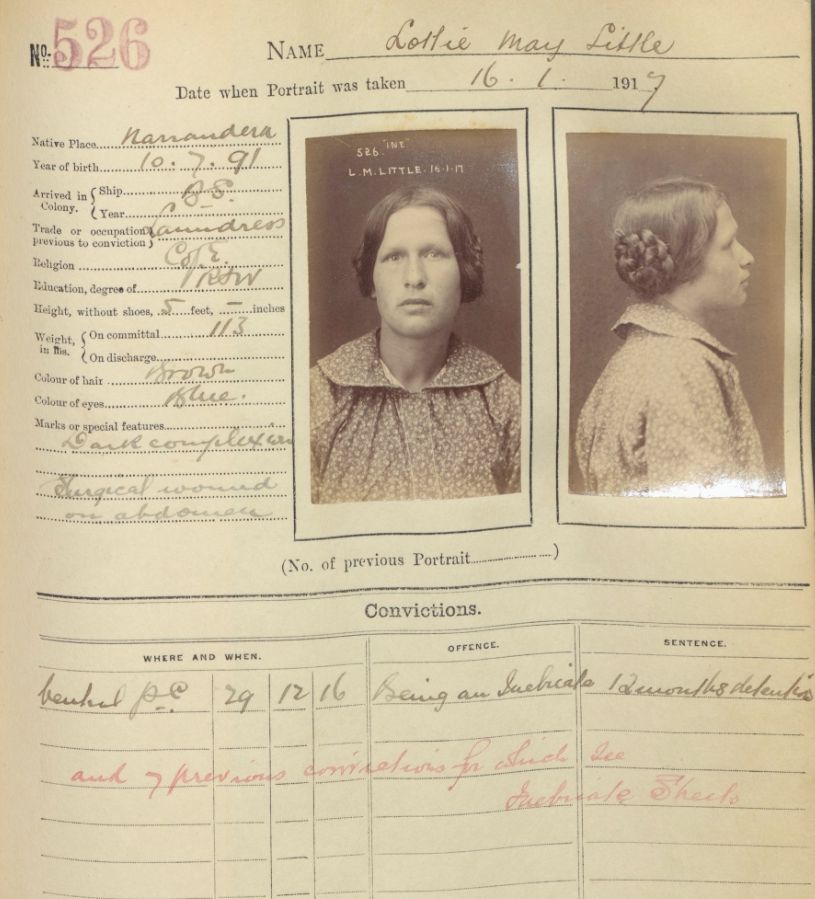
On this day in 1920 Annie Turnbull went on trial for the manslaughter of Alice Berry in the Central Criminal Court in Sydney. She was found guilty but the verdict was later overturned. Annie made regular appearances in the Courts (and gaol records) for abortion related offences over a period of two decades.
May 15
On this day in 1888 Louisa Lawson started publishing the Dawn in Sydney. The Dawn was a monthly journal for women that combined household hints, stories and fashion with political comment on topics such as female suffrage. It was an immediate success and continued to be printed for seventeen years. At the journal's height of popularity it employed 10 female staff, including female printers.
May 17
On this day in 1893 Archduke Franz Ferdinand arrived in Sydney for a private visit. His Imperial and Royal Highness Archduke Frannz Ferdinand of Austria-Este was on a world tour on board the SMS Kaiserin Elisabeth. He spent much of his time in Australia hunting in the NSW outback near the towns of Nyngan and Narromine. The Archduke's assassination in 1914 was one of the catalysts for the beginning of World War I. There are two letters in the Colonial Secretary's Papers (1893/4198 and 1893/6195) and two telegrams in the correspondence of the Governor (2 May and 8 May in 4/1389) dealing with the royal visit.
- See the Colonial Secretary's Correspondence
- See our catalogue for more information about the Governor - Agency #1767
May 18
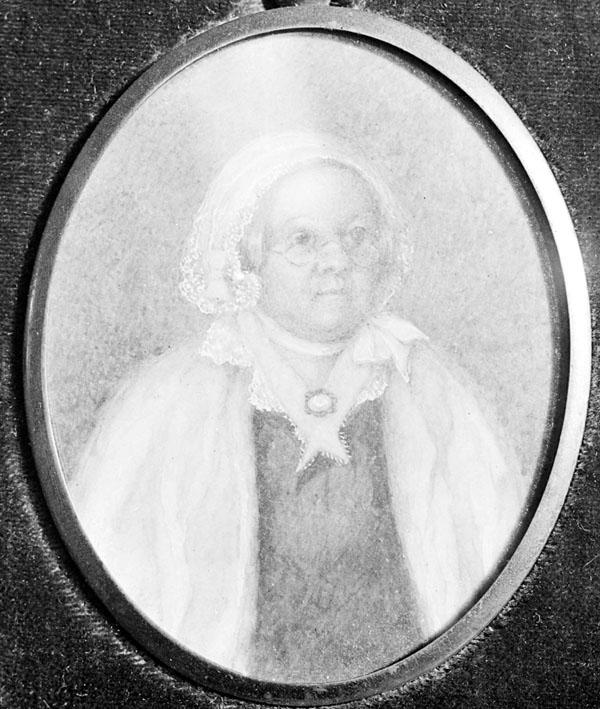
On this day in 1887 convict Margaret Greenwood died in a tram accident. Margaret arrived on the Caroline in 1833 to serve a seven year sentence. She married William Greenwood and had a family but hard luck later in life saw her in and out of prison. Margaret's gaol photo taken in 1875 leaves us with a rare view of a former Imperial convict.
- See more about Margaret Greenwood in our Digital Gallery: Celebrating 50 Years at State Records NSW
- See our Gaol records resources page
May 19
On this day in 1948 the Federal Government announced that Australian rail gauge would be standardised. Three different gauges were in use around the country, meaning that passengers and goods often had broken travel, especially between States. A standard gauge of 1435mm was established for railways between all the state capitals.
- Browse Photo Investigator for images of the NSW railways and rail travel
- Taking Strain Gauge Measurements in Chords

May 20
On this day in 1867 applications for admission to the nautical school-ship, the Vernon, commenced. The Vernon was purchased by the Colonial Secretary in January 1867 and moored in Sydney Harbour. It was intended that vagrant and destitute boys would receive moral, nautical and industrial training along with elementary schooling. The Vernon was replaced with the Sobraon in November 1892.
- See more about the Vernon and Sobraon in our catalogue - Agency 411
- See our fact sheet, Archives in Brief 59 - Child care and protection
- See photos of the Sobraon

May 22
On this day in 1851 the NSW Government made the official announcement of the discovery of gold in the state. Edward Hargreaves discovered the gold at Summerhill Creek, near Bathurst. He notified the Government and was rewarded with an appointment as Commissioner of Land. The following day provisional regulations concerning the issue of licences to mine gold were proclaimed and a Commissioner of Crown Lands for the Gold Districts under the direction of the Colonial Secretary was appointed to carry them out.
- See our catalogue under gold mining
- See our fact sheet, Archives in Brief 120 - Gold mining
- Search the Registers of auriferous (gold) leases, 1874-1953
May 24
On this day in 1838 David Jones opened a store on the corner of George St and Barrack Lane in Sydney. Jones was a Welsh immigrant who moved to Australia in 1835. In NRS 12961 Register of Firms David Jones & Co is listed as purveyors of drapery, furniture and general outfitting. The David Jones store claims to be the oldest continuously operating department store in the world still trading under its original name.
- Search the online index to Register of Firms, 1903-1922
- Barrack and George Streets, Sydney - showing the David Jones Barrack St store

May 25
On this day in 1870 Frederick Wordsworth Ward, also known as Captain Thunderbolt, was shot dead. Ward was the last professional bushranger in NSW when he was killed by Constable Alexander Walker near Uralla. He had escaped from Cockatoo Island while serving a sentence for horse theft in 1856 and settled in the Hunter Valley before taking up bushranging.
May 26
On this day in 1853 the St Vincent transports the last convicts to Van Diemen's Land.
May 27
On this day in 1828 Thomas Livingstone Mitchell became the Surveyor-General following the death of John Oxley. He held this position until 1855 and did much to improve the quality and accuracy of the Surveyor-General's Department. He conducted many exploratory expeditions and published journals of his trips. He died while still the Surveyor General in 1855.
May 29
On this day in 1898 the foundation stones for Australia's first Greek Orthodox Church, the Holy Trinity, were laid in Surry Hills, Sydney. The ceremony was presided over by Archimandrite Dorotheous, who conducted the service in Greek, and was attended by the Consuls-General of Greece and France, the Consuls of Russia, Argentina and Sweden and a large congregation of Orthodox Greeks and Lebanese. The three stones were laid (two in opposite corners, and one in the centre where the altar would be placed) and within each stone was placed a small iron cross, a bottle of holy water and a collection of English and Greek silver coins.
May 30
On this day in 1886 the steamer SS Ly-ee-Moon ran aground off Cape Green lighthouse in southern NSW. The steamer was travelling from Melbourne to Sydney and struck a reef close to Cape Green in strong on-shore winds. The hull broke in two within 10 minutes of the steamer hitting the rocks. Seventy-one people were killed and 15 were saved by lighthouse staff. Among the dead was Mrs Flora McKillop, the mother of Mary McKillop. At the marine enquiry Captain Webber was charged with gross negligence even though he was not the officer in charge at the time of the accident. See Colonial Secretary's Special Bundle on the Wreck of "Lyee Moon" 1886, NRS 906 [4/871.1], available at the Western Sydney Records Centre.
May 31
On this day in 1942 Sydney found itself under attack from three Japanese midget submarines that entered Sydney Harbour under the cover of night. The first submarine became trapped in anti-torpedo nets and the third submarine was sunk in Taylor Bay. The second submarine fired on the heavy cruiser the USS Chicago. One of the torpedos exploded near the depot ship the HMAS Kuttabul, killing 21 sailors.